

Reggie Middleton is an entrepreneurial investor who guides a small team of independent analysts, engineers & developers to usher in the era of peer-to-peer capital markets.
1-212-300-5600
reggie@veritaseum.com


The Winkelvoss ETF application was rejected by the SEC, and bitcoin dropped about 20% in price. I repetitively warned those that followed me that a very low risk buying opportunity will present itself should the SEC deny the ETF application. Like clockwork, instant 30% profit opp. If you were monitoring hte prices and bought in after prices started rising (almost immediately) the buy returned over $250/coin (~30%) for anyone who took my advice.
I'm considering putting together an institutional digital asset (bitcoin and blockchain related assets) investment vehicle. The SEC has clearly delineated what they felt were the deficinecies wee in the Winkelvoss application, to wit:
To my knowledge, the bitcoin exchanges abroad aren't heavily capitalized, but the amount of capitalization needed should be minimal if the exchange is structured properly. Here''s a snapshot of the global bitcoin exchange landscape. Most of the exchange trading is done in USD but the exchanges are domiciled outside of the US (likley due to onerous SEC regulatory requirements). Be aware that I believe most of the institutional trading (in aggregate) is done OTC, and in the US.
This is no longer the case. The PBOC (Chinese Central Bank) has cracked down signficantly on Chinese bitcoin exchanges, ending fee free trading, unregulated margin lending and enforcing AML/KYC procedures. Reference:
The result is a signficant drop in bitcoin trading volume in China, passing the crown first to Japan (who just passed heavy bitcoin regulation, while declaring it legal tender) and then to the US - in direct contravention to said commenter's claim. Take note that once the free trading was halted and central bank regulation took hold, trading volumes in China collapsed in line with the ROW.
This was actually countered by the authors of the ETF application, to wit:
The Exchange, in its comment letter, asserts that bitcoin is resistant to manipulation, arguing that the increasing strength and resilience of the global bitcoin marketplace serve to reduce the likelihood of price manipulation and that arbitrage opportunities across globally diverse marketplaces allow market participants to ensure approximately equivalent pricing worldwide.39 The Exchange further asserts, in its comment letter, that the Commodity Futures Trading Commission (“CFTC”) has designated bitcoin as a commodity and is “broadly responsible for the integrity” of U.S. bitcoin spot markets.40 The Exchange acknowledges that the CFTC has not yet brought any enforcement actions based on the anti-manipulation provisions of the Commodity Exchange Act, but notes that the CFTC has issued orders against U.S. and non-U.S. bitcoin exchanges for engaging in other activity prohibited by the Commodity Exchange Act. The Exchange’s comment letter states that a regulatory framework for providing oversight and deterring market manipulation therefore currently exists in the U.S.41
Another response went as follows:
...Bitcoin is relatively uncorrelated with other assets, enabling investors to construct more efficient portfolios,43 and that, as a general matter, the underlying market for bitcoin is inherently resistant to manipulation.44 The author of the paper posits that the underlying bitcoin market is not susceptible to manipulation because (a) there is no inside information related to earnings, revenue, corporate actions, or new sources of supply; (b) the asset is not subject to the dissemination of false or misleading information; (c) each bitcoin market is an independent entity, so that a demand for liquidity does not necessarily propagate across other exchanges; (d) a substantial over-the-counter (“OTC”) market provides additional liquidity and absorption of shocks; (e) there is no market-close pricing event to manipulate; (f) the market is not subject to “spoofing” or other high-frequency-trading tactics; (g) order books on exchanges worldwide are publicly visible and available through APIs (application program interfaces); and (h) it is unlikely that any one person could obtain a dominant market share.45 The author also asserts that listing the shares on a national securities exchange and a shift from OTC trading to trading on exchanges would make the overall bitcoin market more transparent.
There were also public comments deriding the Gemini exchange, directly. While I don't, personally, care for the Gemini exchange, some of the issues taken with it were impractical. For instance:
Listen, no market is perfectly efficient, and early markets are likely to be particularly inefficient. That's one of the main reasons to introduce an ETF, to inject liquidity and efficiency. Even the largest and most efficient market in the world has trade failures, as has been noted by Bloomberg:Failed Trades in 10-Year Treasury Soar as Note Stays `Special':
The shortage of benchmark 10-year Treasury notes in the market for borrowing and lending U.S. government debt has become so pronounced that uncompleted trades are soaring. Such trades, known as fails, surged into the billions of dollars in recent days for the newest 10-year note, and may have been in the range of $6 billion to $12 billion, according to Treasury market participants familiar with the matter who requested anonymity because the figures aren’t public. While uncompleted trades occur daily, sometimes because of computer glitches, it’s unusual for the level to be so high. There were $132 million in failures for all 10-year Treasuries in the week ended Feb. 24, the latest data from the Federal Reserve Bank of New York show.
I can go deeper into the SEC declination analysis for insitutional subscribers who may be interested in creating or partipating in an institutional vehicle to access bitcoin exposure. Let me know.

The markets have gotten euphoric since the Trump election, apparently because someone believed what he was selling. Take a look at the broad market jump (powered greatly by the bank jump), and even more unbelievably the bank index jump.
Bloomberg reports G-20 Drops Anti-Protectionist Pledge as Price of U.S. Assent. Long story short, here comes global protectionism as countries attempt to deal with the lead that Trump's administration has wrought. Don't believe what is said, believe what is done.
As free trade comes under pressure, you see the many campaign promises of the new administration get pushed back or outrigh fall to the wayside. Reference our post from earlier this month First 45 days of Presidency: Efficiency Fact Check Shows Us What to Expect Regarding Policy and you'll notice that from an efficacy perspective, it is highly unlikely that Trump will be able to push through the infrastructure spending and tax cuts that he proposed in the near future. That means that the markets have gotten way ahead of themselves - particularly as it seems that protectionist trade policies are likely to do much more harm than good.
Hence, back to the query posed last month:.Is Time to Short America? Macro Risks + Unpredictable Administration / Geopolitical Uncertainty = ? and Is It Time to Short America?, Part 2: Crony Capitalism Leads to Socioeconomic Stratification - the Rich Get Richer!

A hedge fund recently made news by securitizing its LP units as Ethereum-based tokens and selling them as tradeable (thereby liquid) assets. This brings technology to the VC industry that should truly challenge the extant VCs right? Well, yes and no. You see, the tokenized thingy is cool and all, but it really doesn't take full advantage of the technology at hand. After all, 2.5% & 25% is a pretty steep fee. Veritaseum, in anticipation of its upcoming ICO online road show and executive summary is prepping to launch what we call an ICODAO, and Distributed Autonomous Organization that collects Initial Coin Offerings. We are attempting to make this nearly completely autonomous, tested (don't think "TheDAO" debacle, and considerably cheaper than hedge funds that you see these days. Now, the ICODAO is not a hedge fund, or a fund of any kind. It's sort of an autonomous software entity, that uses our software token, "Veritas" to allow other entities and individuals to gain access to its accumulated exposures and services. Those services are basically the sniffing our and collecting the best of the best ICOs and token offerings available, and the exposures are the natural result of the collection and holding of said ICOs. A world class research team will supply the analytical chops (click here if you don't know, the same team that predicted Bear Stearns, Lehman, CRE and housing crash, Google, EU sovereign debt crisis, etc.). Back to that in a minute, let's look at what's happening in the world off(block)chain.
Bloomberg reports "Yale Endowment Blasts Low-Fee Critics, Says Gains Would Lag, as excerpted:
Yale University, one of the most-watched and best-performing college endowments, defended the fees it pays to external managers, saying in an annual investment report that a low-cost passive strategy would have “shortchanged’’ the Ivy League school’s students and faculty.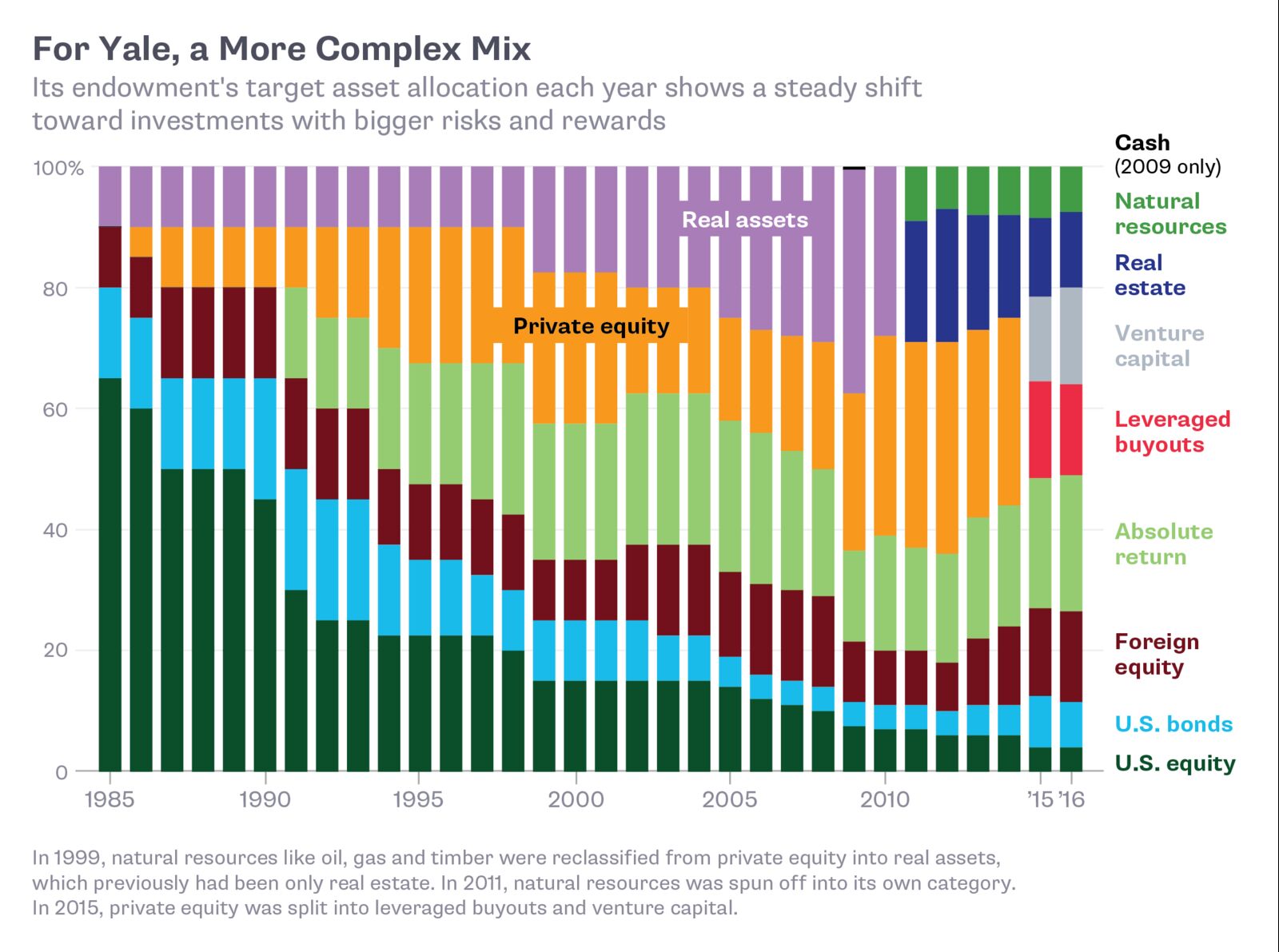
Fees for private equity and hedge fund managers, some of whom command 2 percent for management and 20 percent for performance, or even more, have become a heated topic. Berkshire Hathaway Inc.’s Warren Buffett and writer Malcolm Gladwell have taken public shots at the structure, and Gladwell specifically targeted Yale two years ago.
“What Buffett, Gladwell and other fee bashers miss is that the important metric is net returns, not gross fees,’’ the report said. “Weak or negative returns would result in low or no performance-related fees, but would be a terrible outcome for the university.’’
Yale’s investment strategy emphasizes long-term active management of equity-oriented, yet often illiquid assets, with more than half the fund in alternative investments. Almost a third of Yale’s 2016 allocation is in private equity, including 16.2 percent in venture capital and 14.7 percent in leveraged buyouts. About 22 percent is in absolute return with hedged-like strategies.
“Performance-based compensation earned by external, active investment managers is a direct consequence of investment outperformance,’’ it said.
Yeah, I get it. Some guys are just better than others at investing, and they should be compensated commensurately. The question is, are there high performers that can be had for less than 27% of your profits? Let's take a look at a theoretical blockchain focused hedge fund vs the ICODAO - from a graphical perspective. Realize that the ICODAO charges a flat fee for its services. It's not a hedge fund, so there are no performance fees, but there are certain things that it may not be able to do on its own (yet), hence has to contract out for. The fees are to cover what it takes to make this autonomous entity self sustaining. It may very well be the case that these fees will shrink over time. We don't know, we're breaking new ground here. The hedge fund fees are self explanatory.
There you go. In a nutshell. Here's more...
Yes, the machines are taking over! Be sure to take part in the Veritaseum Token Offering, take part in the paradigm shift! Feel free to contact me directly with any queries via the contact form in the top menu.

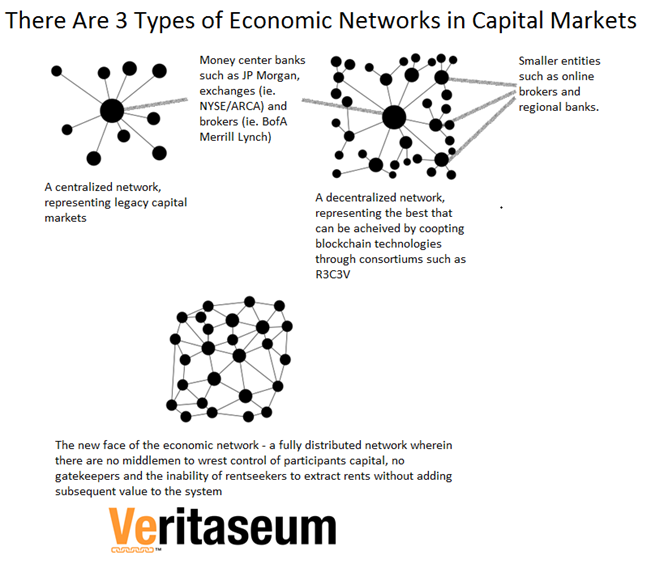
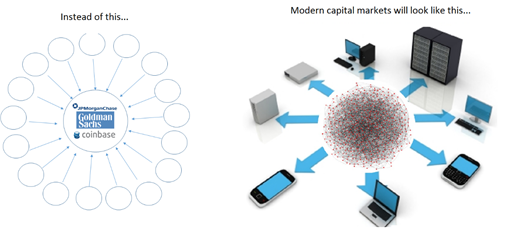
Veritaseum is in the process of building peer-to-peer capital markets that enable financial and value market participants to deal directly with each other on a counterparty risk-free basis in lieu of going through middlemen, intermediaries and authoritative 3rd parties.
We are holding an ICO (a cryptographic offering) for our Veritas tokens: the sole means of accessing the vehicles for the P2P economic markets.
Here is an overview of the ICO details. The online Veritas presentation deck is rich with descriptions and links to other documentation and instructions on participating should you want to dig in deeper.
Executive Summary
Veritaseum is to be considered a gateway, or onramp to the P2P economy, akin to how a browser is used to access the World Wide Web, or a Bitcoin or Ethereum wallet is used to access those distributed ledger platforms.
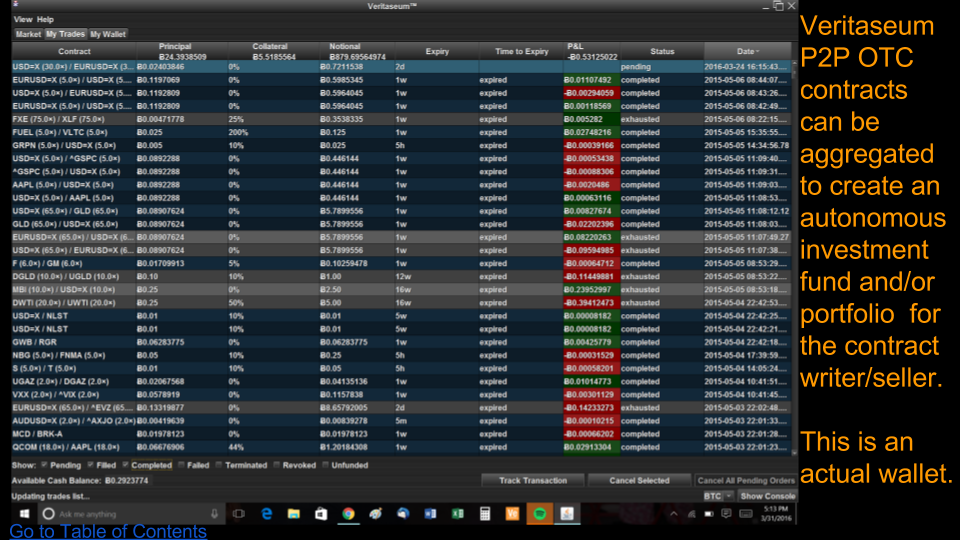
Veritaseum’s wallet uses a layman friendly interface to build, distribute, read and execute smart contracts.
The Veritaseum wallet interacts with Bitcoin and (soon) Ethereum blockhains and oracles to conditionally store and transfer value.
Veritaseum’s primary competition will initially be the sell side Wall Street status quo. Its aim is two-fold:
o provide autonomous asset management and investment vehicles (DAOs) at near zero profit margin, drawing assets from the more traditional players and then selling information, data and advisory services on top of it;
Enable self-service P2P smart contract transactions over-the-counter, that mimic the transactional services of the legacy players, at considerably lower cost and without balance sheet exposures, credit risks or counterparty risks.
This near zero margin model will be replicated as a platform across the entire FIRE sector (finance, insurance and real estate), and then to sharing economy models (ie. Uber, AirBbB).
Veritas launched a long-running beta of its OTC value trading platform in 2013 and claims to not only be the first publicly viable P2P capital markets implementation of smart contracts technology but to to be the first to file for patent protection of the same.
Management pulled the Wallet from public access soon after the CFTC announced their regulation of bitcoin out of concerns of a requirement to register as an SEF (swap execution facility). Management’s goal is to be, and to remain, solely a software, software data services and advisory provider - and explicitly not a financial concern.
Veritaseum is moving to the Ethereum blockchain, while still retaining exposure to the Bitcoin token, in order to broaden its smart contract capabilities.
Veritaseum provides direct access to smart contract construction, execution and related products the non-technical individual. This direct access facilitates access to what Veritaseum management has coined the “Peer-to-Peer capital markets” - essentially an ever growing pool of users who transact value directly with each other instead of through intermediaries and middlemen, ie. Wall Street banks and brokerages. Veritaseum sees highly customizable and programmatic, direct, P2P transactions as the future of capital markets.
In addition, with the advent of low cost networking and geogrpahically aware computing power (smart phones), blockchain tech and smart contracts, the concept of transferrable value is easily expanded past real and financial assets to privacy, labor, data and a cornucopia of things none of us have through of yet.
All assets are stored client side, fully encrypted and are always in the complete control of the client (i.e., you, the individual user). Veritaseum doesn’t even store encrypted copies on its servers. Even in the event of a password compromise, bad actors must also locate the assets to access them. Something that is much easier to do on a centralized server (e.g., JP Morgan or Citibank) than a fully distributed system.
With Veritaseum, one can literally tweet an entire trade, or click a Friend on Facebook to take the other side of a short Goldman long Facebook trade, or transfer BTC linked to the price of gold through a text message. All without having to trust who’s on the other side! This level of friction free finance leads to the inevitable…
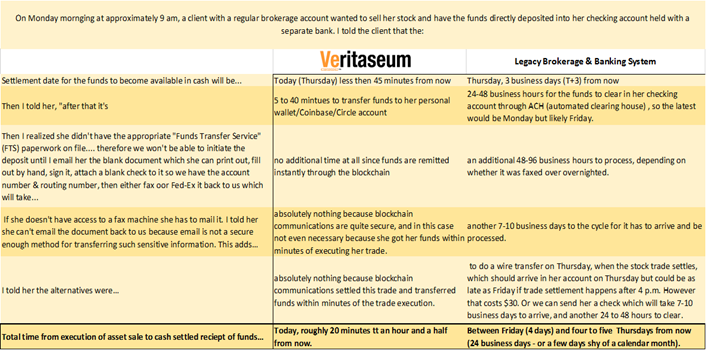
In the legacy financial world, in order to open a bank account, you have to present various forms of ID, go through multiple levels of KYC/AML, and wait a few days for funds to clear. In order to open a brokerage account, you have to fill out forms, answer questionnaires, meet minimum account balances and wait up to 3 days for funds to clear and 10 to 20 business days for assets to be transferred from account to account. All this is done to essentially remand control, custody, possession, and ownership of your funds and assets to a centralized hosted wallet (bank or brokerage) with oodles of balance sheet exposure to other centralized hosted wallets (banks, brokerages and exchanges). In return, you are given a promise not to plunder. With Veritaseum, you can create multiple accounts in under 60 seconds. You can start trading and transacting with others almost immediately, and in all cases no less than 60 minutes provided you have bitcoin on hand.
This ability to do practically everything your bank and brokerage offers through your browser (for dramatically less money) on practically any web-connected device with a modern browser, practically anywhere, with almost anyone, and without having to trust them inevitably leads to a massive proliferation of transactions. This proliferation will spread exponentially, not linearly, as more and more people realize they have been essentially freed from the “Matrix”.
· This is what AT&T; was afraid of in 1915, causing them to miss out on roughly 7 billion “new” customer accounts, and potentially controlling the telecommunications space.
· This is what AOL was afraid of in the mid to late ‘90s, causing them to go from the Internet access market leader to an “also ran” in the space.
· This is what the banks and financial industry are fighting against now, likely to have no more success than their historical compatriots in other industries.
This growth and proliferation in peer-to-peer transactions, is truly viral. The outbreak will not be media or telecomm this time around, but the very meaning, application, and use of money and value itself! This is the dawn of “Pathogenic Finance”!
A pathogen is an infectious agent that disrupts the normal physiology of an organism. In this case, the disease is a new cultural meme. Pathogenic finance is a concept discovered and coined by Reggie Middleton, Disruptor-in-Chief at Veritaseum. Veritaseum acts as a virion (infectious virus particle) for carrying new pathogenic cultural memes, ideas, and practices of finance that can be transmitted from one mind to another through writing, speech, rituals, or media. Regardless of what the meme is transmitted through, it is transmitted by… Veritaseum. It is analogous to a virus in that it self-replicates, mutates, and respond to selective pressures on organisms to evolve (i.e., changes in habitat, weather, food availability and type, etc.). Veritaseum, like its biological counterpart, can infect multiple forms found throughout multiple ecosystems. Viruses are the most abundant type of biological entity. Being that Veritaseum now lives as a web page, it can live and multiply anywhere there’s an Internet connection and modern browser. Any geographic location, any device, any user. All it takes is a single Tweet, text, email, or drag and drop to get Veritaseum value transactions to spread and multiply.
The Veritas token will act as the key and only gateway to access the contracts that build the P2P capital marktes. The Veritas token is easily programmed (by the non-technical user) to take on the market exposure attributes of nearly any other financial or real asset or commodit that has a generaly accepted and accessoble data feed and/or price discovery. As such, Veritas also acts as the fuel to run the P2P capital market’s engines.
The Veritas ICO will be capped, guaranteeing the scarcity of Veritas, Negotiations are being made to have Veritas accepted off blockchain by legacy institutions.
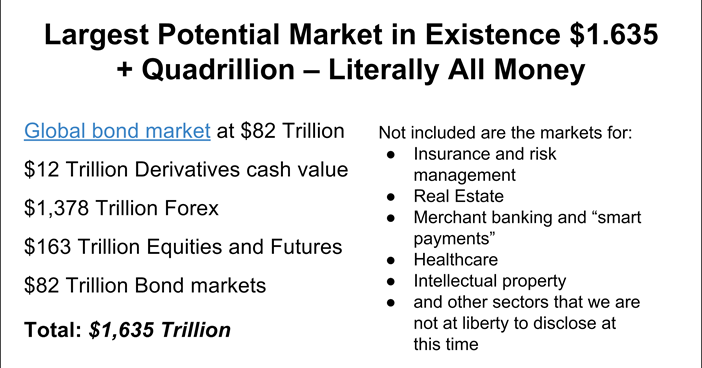 Putting this into perspective, that.s $16.35 of value for every basis point of market penetration. Five basis points of real penetration across markets will dramatically increase the demand and scarcity of Veritas.
Veritaseum doesn’t have to take over marktes, it simply has to ensure relaible usage in a very small subsection of markets.
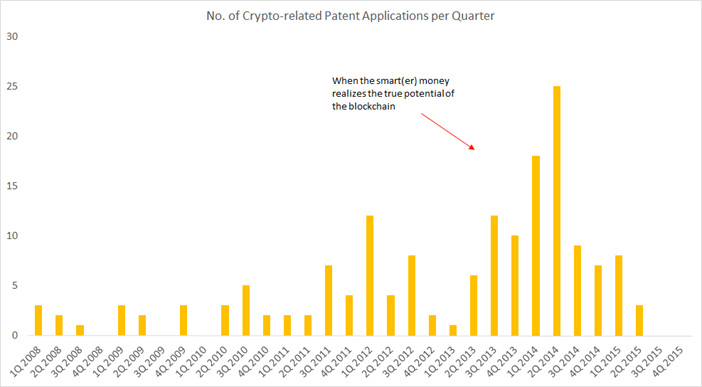 The smart(er) money appears to have started filing financially focused cryptocurrency-related patent applications in the 1st and 2nd quarter of 2014.
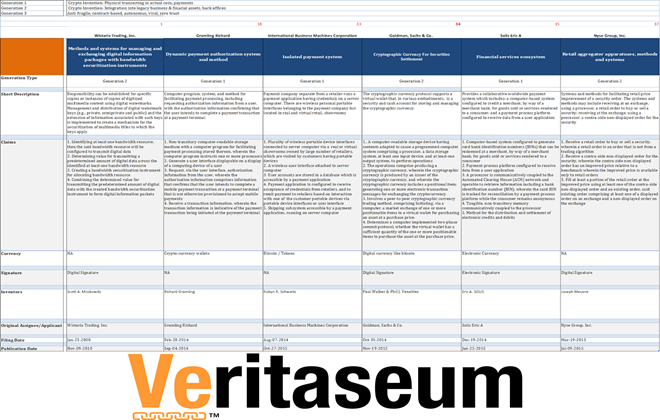
For more information:
See our crowdsale presentation:
Download the Pathogenic Finance report and view the video.
Come back to Veritaseum.com at the open of NY financial markets (9:30 am, EST sharp) on April 25th, 2017 to purchase your Veritas, and own your keys to the P2P Capital Markets.

A YouTube commenter asked a very good question that we will like to take some time to answer. The question was, verbatim:
The cost will be our stated rates, and will fluctuate with the VeUSD exchange rate. The advantage of using Ve over cash is that our consulting and advisory services are a very scarce commodity (like most labor), although the research is much less so (as it can scale via platform). Thus, Veritas holders get priority. I want to make it perfectly clear that Veritas ICO is much, much more than mere research and advisory. Consider that the icing on the cake. The ability to redeem your Ve against us gives instant value. In addition, we have a working, beta product already developed (not quite production ready for the masses, but it has been running in the public doman for serveral years now). In addition, we also own our IP. Where some coin offerings only offer the promise of future development (as do we, to be sure), we also have something to offer in the here and now.

Note: Subscribers should reference the paywall material here for stocksthat should give a good risk/reward scenario for bearish trades.
The Trump administration's legislative outlook is effectively a political desert, with no signs of material legislation either proposed or in sight. The multiple failures of the travel ban and rapid disintegration of the healthcare bill has effectively given Trump the mantle of the nations first lame duck president with only 2 months in office.
He has expended his political capital on multiple failed policy very early on, purposely alienated many factions, and is now mired in an FBI investigation - not to mention suffering from permanently impaired credibility stemming from an unending cornucopia of unsupported accusations, assertions and allegations (ie. he's lying too much).
What does this portend for investors in the short term?
In December and January, I penned "Is Time to Short America? Macro Risks + Unpredictable Administration / Geopolitical Uncertainty = ?" Is It Time to Short America?, Part 2: Crony Capitalism Leads to Socioeconomic Stratification - the Rich Get Richer!" The titles speak for themselves. I also gave warning via my Max Keiser interview here.
Let's be clear here. Obamacare is essentially a comprehensive and complex tax designed to fund universal healthcare insurance. Trump ran on the premise that he was a proven master negotiator and would use said skills to repeal and replave the Obamacare tax, recreate US tax policy on a massive scale and deregulate business. The vast majority of this requires legislation. Trump has failed at the most visible portion of his campaign promises horribly, and as a result he's burned a vast amount of political capital with nothing to show for it. In addition, he's lost signifcant credbility through the various fires he's been trying to put out (many of which are sel-inflcted). The result of all of this is a raft of legistlators, political power players and influencers who will not risk sticking their neck out for what is essentially already lame duck president.
In order to revamp tax policy in any meaningful way, you will need a massive amount of bi-partisan political capital - capital that Trump simply cannot deliver. The result? You tell me, after considering how much US markets have already assumed Trump would be able to wield his poltical capital to corporate benefit.

My prediction of Sears collapsing once interest rates started ticking upwards was absolutely on point.
I gave the warning years ago. Basically, with low margins, negative growth, increasing competition from Internet sales and substantial debt, Sears was at the behest of interest rates. Once they ticked materially higher - Boom!
This is the most telling quip from my missive 6 years ago:
I discussed the effects of this on retail malls last week in The Greatest Risk To Retail Commercial Real Estate Is? Sovereign Debt! Macro Headwinds! Popping Bubbles! Busted Banks! No, It's The Internet! The kicker is the effect on Sears will be most exaggerated since it has real estate, fundamental, macro, industry induced and management issues to deal with as well as the paradigm shift towards internet shopping (which it should have been able to hedge with Sears.com and Kmart.com, alas this brings us back to the management issues, doesn't it?
Subscribers can access some of the legacy research here:
Those who don't subscribe can view a preview below. Access to our services without direct interaction with our staff is now avalable for as little as $11 per month.

TV has changed more in the past 10 years than it has since it's inception nearly 100 years ago This change is profound, and the primary benefactors look and act like nothing the traditional TV companies are used to. It shows, as they are losing market share to the new guys in droves at lower margins. Let's take a closer look...
Television was invented in 1925 by a 21 year old Scottish inventor named John Logie Baird
As with most technologies, it was spatialized, little known and not very user friendly. Other inventive types made moves to increase the user friendliness of Baird's inventions, but big business has yet to build a business model around the tech.
Industry pundits are doubtful of the market opportunities of such a device, but it spread regardless.
Twenty years after the introduction of the technology, RCA corp. takes the technology into mass production.
This is the point at which the content creators and distributors started to ramp up. Studios to create content for this new "visual radio" format and distribution networks in the form of TV broadcasters started forming. All content was distributed through the airwaves via antennas. Despite incremental changes in business practices, the business model of the TV content creators and distributors (often vertically integrated as one) had not changed from the 1940s to 1970s... Basically, an ad-driven revenue model (TV commercials).
Despite a rather stagnant business model on the content distribution end, the receiver technology did progress and advance. Cathode ray tube televisions provided clearer pictures and color images.
The advent of coaxial cable allowed for greater, uninterrupted bandwidth, meaning less terrestrial interference and more reliability (think aluminum foil on metal TV antenna sticks, snow on the screens and wavy pictures when it rained or snowed).
With coaxial cable came a new, unique business model - cable television. This model relied on monthly subscription revenue in lieu of advertisements. It provided higher margins, in large part due to the high upfront capital costs of laying the cable in the ground (or air via poles) and capital-intensive servicing.
Roughly ten years later, the satellite TV industry emerged. It ran along a similar subscription fee business model, but boasted theoretically better margins for there was only one large upfront cost (launching or buying access to the orbital satellite which beams content down to terrestrial receivers in homes). This allowed greater reach with less capital outlay for the less densely populated areas.
Meanwhile, in the homes, receiver technology advanced much faster. Televisions with plasma displays arrived, allowing for the relatively bulky cathode ray tube TVs to be replaced with slim panels whose images are formed by energized plasma gas in the late 1990s and early 2000s. Plasma TVs then gave way to LCDs (liquid crystal diodes) which allowed for higher resolutions about 10 years later. Plasma and LCD TVs (flat panel devices) introduced the era of HD (high definition) television in which the images approach reality in terms of resolution (at least when compared to CRTs).
At the same time, the Internet and its' interlinking overlay, the World Wide Web, became popularized and startups introduced the concept of streamed and downloadable video content through the "cloud". Examples were YouTube, Amazon and Netflix.
The advent of video streaming caught on much faster than both the established video content creators and distributors, as well as the reception device manufacturers thought possible Their slow to react response times made room for an entirely new business and business model, for receiver manufacturing companies as well creators and distributors.
This is what the most used receiver tech looks like now - a far cry from what the industry was used to for the previous 90 years. Ironically, the 2nd most popular receiver manufacturer is a computer company - Apple.
Smart phones now outnumber computers and traditional TVs in both sales and presence in the home and business. It has also transformed the way content is consumed, worldwide.
Throughout the 50s, 60's 70's, 80's and 90s television consumption was often an group or family led past time, due mostly to the expense of the devices, immobility and linear nature of the programming, ie. your favorite show comes on at 8pm on Wednesday. In order to see it live (or before VCRs and DVRs, to see it at all, you had to be in front of the TV at that time.
Now, the new streaming services allow "on demand" access and all you can eat, personalized consumption on very portable devices that can fit in your pocket. As a result, the behavior of the demographics, as well as the demographics themselves, have changed dramatically.
The most popular manufacturer is not even an American company. One South Korean company, Samsung, was able to capitalize on both the legacy and the paradigm shifted receiver technology. They manufacture the screens for the two most popular handheld devices, and the high end screens for the traditional home device, the flat screen TV.
As a result of their prominence, they have led the way in integrating Internet and WWW aspects into the TV experience regardless of form factor.
Leading edge companies such as Samsung are now pushing the boundaries of resolution, with 8k large screen TVs that were once the purview of commercial movie theaters at consumer prices. What was bleeding edge tech costing $10,000 just a few years ago (HD and 4k Ultra HD) are now available on relatively inexpensive $100 to $700 phones that fit in your pocket and are carried around by about 80% of middle school-aged children, complete with full video content production, consumption and real time transmission and broadcasting capabilities.
Reality, picture quality and resolution are are culminating in the newest crop of OLED (organic, light emitting diode) screens which give better than photorealistic quality.
This level and quality of presentation is now available through real time streaming to any device, regardless of form factor. As a matter of fact, the Samsung phones have had advanced versions of OLED, (super AMOLED) screens for over 4 years now..
All paying subscribers can click here to access the analysis of the various content producers and distributors to see how things are changing, who's benefitting from the change and whose losing out. Click here to subscribe Now, on to Subscriber Level Overview of the Transformation of the TV Content Industry.

LedgerX's "SOLIDX BITCOIN TRUST" has an approval deadline this March 30th, 2017.If it is approved, Bitcoin is due for one hell of a bump, but...
There is a very material chance that it won't be approved. This is not a bearsh event, despite the fact Bitcoin will most assuredly sell off and do so sharply. Let's take a cursory look at what the SEC wants, and what it has received thus far in regards to bitcoin submissions.
The SEC's declination letter, says, and I quote:
"The Commission views the Exchange’s proposed surveillance procedures regarding the Shares themselves as necessary, but not sufficient in light of the discussion below noting that the Exchange has not entered into, and would currently be unable to enter into, surveillance-sharing agreements with significant, regulated markets for trading either bitcoin itself or derivatives on bitcoin.100 Moreover, the Commission does not accept the premise, suggested by some commenters, that regulation of trading in the Shares is a sufficient and acceptable substitute for regulation in the spot or derivatives markets related to the underlying asset."
In short, the underlying of the Trust has to be regulated in order for the SEC to consider it safe enough for manipulation surveillance. Of course, the Winkelvoss brothers' ETF submission wasn't based upon a regulated underlying, because to date- there is no US federally regulated bitcoin trading entity (at least that i know of, and apparently none that the SEC knows of as well).
This also boils down to the index construction that both the SolicX and the Winkelvoss twins used - both use pricing indices that are largely reliant on unregulated exchanges in foreign domiciles, to note:
With respect to spot bitcoin trading outside the United States, the information in the Exchange’s proposal and from commenters demonstrates that the bulk of bitcoin trading occurs in non-U.S. markets where there is little to no regulation governing trading,
This is no longer the case, hence is rebuttable, but...
The Exchange notes in its comment letter that only a minority of the global spot bitcoin exchanges are subject to any regulatory regime.105 Additionally, the Commission notes that no bitcoin spot market is currently a member of the Intermarket Surveillance Group.
Note these excerpts from SolidX's submission for their ETF...
They are almost the same as what has been rejected by the SEC re: Winkelvoss.
Fear not, the SEC laid clear a very obvious solution (which we will not get into here) that makes known to anyone who is paying attention that they are quite open to having a bitcoin ETF in the US. As a matter of fact, they (like I) seem to believe it is a forgone conclusion.
BTFD!
Click here to , and . I would very much be willing to work with anyone who has the capital and is interested in forming an ETF that will pass muster with the SEC. They have made clear the path to success.

Someone with over 53 years on Wall Street sent me this article from Lex of the Financial Times...
his article is full of errors and misconceptions. I clarified most of them last week in "Why the Wineklvoss Bitcoin ETF Was Rejected and How to Create a Regulated Vehicle That Passes Muster". In said article I demonstrated that China doesn't have the majority of trade volume. That's just WRONG!
The SEC's problem with Gemini's market reach is easily rectified by thier not trying to be so vertically stack and sharing liquidity with other exchanges - something that will likely have to happen anyway. As you can see, bitcoin exchange trading in its totality, represents a very small portion of bitcoin trading.
Most BTC trades are P2P and/or OTC. Lest the SEC complain about that, real estate is handled the same way (and unregulated) yet there are plenty of real estate ETFs. Now, despite the fact that most BTC is traded OTC, you can still buy your BTC at or close to exchange prices. Yes, a large purchase may create some slippage, gaps and spreads, but that is the same nature of any thinly traded market - and BTC is much more liquid than most - again, referencing the real estate market. No market maker in commercial real estate can be assured he can pick up office building or condo units at a certain price or spread, or even the entire complex.
The fact that Lex is comparing Bitcoin to cannabis shows a material misunderstanding of what bitcoin is. Silicon Valley gets it, which is why Microsoft, IBM, et. al. are jumping on board (bitcoin is more akin to the Internet than it is to weed), but the finance guys in the east are still behind the curve. Unfortunately, it appears the finance guys in the east don't even understand the financial portions of Bitcoin. Reference my educational articles from the recent past. After reading what is essentially Fake News about Bitcoin from Financial Times, London Business School and Credit Suisse, I have created an easy to understand metric that allows anyone to compare the risks and rewards of Bitcoin to basically any currency, commodity, stock or asset class.
Now, taking into consideration the (properly) risk-adjusted reward of bitcoin relative to most major asset classes, one can easily understand why smart institutional investors would want some exposure - hence the rush to build ETFs. Take a look at what will happen to bitcoin prices if such ETFs were to be approved.
You see, the introduction of even a small ETF will set the Bitcoin platform on FIRE!
Click here to subscribe to our paid research, and This email address is being protected from spambots. You need JavaScript enabled to view it..
Reggie Middleton is an entrepreneurial investor who guides a small team of independent analysts, engineers & developers to usher in the era of peer-to-peer capital markets.
1-212-300-5600
reggie@veritaseum.com


