
Reggie Middleton is an entrepreneurial investor who guides a small team of independent analysts, engineers & developers to usher in the era of peer-to-peer capital markets.
1-212-300-5600
reggie@veritaseum.com
Donald Trump's recent Tweet discusses how Russia has gotten stronger at the behest of President Obama.
For eight years Russia "ran over" President Obama, got stronger and stronger, picked-off Crimea and added missiles. Weak! @foxandfriends
— Donald J. Trump (@realDonaldTrump) March 7, 2017
Let's take an empirical look at that claim.
Last week I queried "Is Bitcoin the Undisputed Best Performing Asset Class In the World?". The purpose of that piece and the piece before it was to debunk long standing misconceptions as to the actual investment performance of BTC (bitcoin) as portrayed by respected institutions such as the London Business School and the Financial Times, not to mention Money Magazine.
Now, it's time to get into exactly what value propositions are there to support bitcoin's price.
Reading a Bloomberg article on the topic of ass-backwards EU area government moves this morning caused me to query, "What is the extent of the fear the European (and US) governments have of the financiers?" In Cyprus, we have a case of a government that would actually rape the depositors of a bank rather than the investors who voluntarily, directly and explicitly accepted the risk of bank failure through speculative investment (ex., the bondholders).
The bank tax was the alternative to imposing losses on investors in a so-called bail-in, a step opposed by the Cypriot government, the European Commission and the ECB, German Finance Minister Wolfgang Schaeuble said on ARD television last night.
So, you will bend the mom and pop depositors over, but leave the monies of the institutional guys who should have known better sacrosanct?
“It’s up to them to explain it to the Cypriot people,” Schaeuble said. “Clearly, the taxpayer should not be asked” to rescue banks from insolvency, he said, adding that Cyprus faced a “very difficult time” unless it accepts the tax.
Bullocks! The taxpayer should be hit before the depositor to maintain the confidence in the banking system, but they should all stand behind the bondholders who accepted the investment risk in the first place. Yes, I'm aware that the banking system of Cyprus is about 9 times the size of its real economy, but that's pretty much the case with much, if not all of the EU, as clearly delineated 3 years ago in Ovebanked, Underfunded, and Overly Optimistic: The New Face of Sovereign Europe:
I will attempt to illustrate the "Overbanked" argument and its ramifications for the mid-tier sovereign nations in detail below and over a series of additional posts.
 image015.pngimage015.png
This is just a sampling of individual banks whose assets dwarf the GDP of the nations in which they're domiciled. To make matters even worse, leverage is rampant in Europe, even after the debacle which we are trying to get through has shown the risks of such an approach. A sudden deleveraging can wreak havoc upon these economies. Keep in mind that on an aggregate basis, these banks are even more of a force to be reckoned with. I have identified Greek banks with adjusted leverage of nearly 90x whose assets are nearly 30% of the Greek GDP, and that is without factoring the inevitable run on the bank that they are probably experiencing. Throw in the hidden NPAs that I cannot discern from my desk in NY, and you have a bank that has problems, levered into a country that has even more problems.
 image009.pngimage009.png
Of course, this boneheaded move will backfire tremendously because it appears as if the members of the Cyprus government are not aware of the true financing structure of the banking system. DEPOSITORS SHOULD REMAIN SACROSACNT! They are the most important source of funding, not to mention the most liquid (as in potential for capital flight) in the entire banking ecosystem! I reviewed this structure and the inevitability of European bank runs two years ago in The Anatomey of a European Bank Run!
 image012
Using this European bank as a proxy for Bear Stearns in January of 2008, the tall stalk represents the liabilities behind Bear's illiquid level 2 and level 3 assets (including the ill fated mortgage products). Equity is destroyed as the assets leveraged through the use of these liabilities are nearly halved in value, leaving mostly liabilities. The maroon stalk represents the extreme risk displayed in the first chart in this missive, and that is the excessive reliance on very short term liabilities to fund very long term and illiquid assets that have depreciated in price. Wait, there's more!
The green represents the unseen canary in the coal mine, and the reason why Bear Stearns and Lehman ultimately collapsed. As excerpted from "The Fuel Behind Institutional “Runs on the Bank" Burns Through Europe, Lehman-Style":
The modern central banking system has proven resilient enough to fortify banks against depositor runs, as was recently exemplified in the recent depositor runs on UK, Irish, Portuguese and Greek banks – most of which received relatively little fanfare. Where the risk truly lies in today’s fiat/fractional reserve banking system is the run on counterparties. Today’s global fractional reserve bank get’s more financing from institutional counterparties than any other source save its short term depositors. In cases of the perception of extreme risk, these counterparties are prone to pull funding are request overcollateralization for said funding. This is what precipitated the collapse of Bear Stearns and Lehman Brothers, the pulling of liquidity by skittish counterparties, and the excessive capital/collateralization calls by other counterparties. Keep in mind that as some counterparties and/or depositors pull liquidity, covenants are tripped that often demand additional capital/collateral/ liquidity be put up by the remaining counterparties, thus daisy-chaining into a modern day run on the bank!
 image006
I'm sure many of you may be asking yourselves, "Well, how likely is this counterparty run to happen today? You know, with the full, unbridled printing press power of the ECB, and all..." Well, don't bet the farm on overconfidence.
I'm currently preparing the release of a report that will make the Cyprus affair look like peanuts as this contagion reinfects the core and I produce so much evidence of apparent fraud as to make your nose bleed. Stay tuned, and follow me:


As a Memorial Day gift to paying subscribers, I am offering a 22 page recession comparative analysis that shows specifically which indicators led the S&P 500 into an out of the last three recessions (of course, we are out of the last one yet, so the exit is incomplete). I noticed many people simply regurgitate what they hear in the media or from XYZ renowned pundit, in lieu of looking the data up for themselves. Many may be shocked to find out exactly what is a leading vs. a lagging indicator, and which indicators actually indicate nothing at all. This work should also go a long way in helping many discern whether we are in a bear market rally or the beginning of a new bull market, which is the reason why I commissioned it in the first place. I've always have to stress test my thesis!
Subscribers should feel free to discuss this (and only this) macro analysis openly in the public comments section, if they so desire. It can be downloaded here:  An unbiased, independent retrospective comparative review - April 2009 2009-05-22 11:26:07 781.96 Kb. Professional/institutional subscribers also have access to the data-heavy 7.5 megabyte spreadsheet that was used to power the the analysis. Yes, I am feeling particularly generous today:
  Business Cycle Comparison 2009-05-22 11:17:12 7.44 Mb.
As a Memorial Day gift to paying subscribers, I am offering a 22 page recession comparative analysis that shows specifically which indicators led the S&P 500 into an out of the last three recessions (of course, we are out of the last one yet, so the exit is incomplete). I noticed many people simply regurgitate what they hear in the media or from XYZ renowned pundit, in lieu of looking the data up for themselves. Many may be shocked to find out exactly what is a leading vs. a lagging indicator, and which indicators actually indicate nothing at all. This work should also go a long way in helping many discern whether we are in a bear market rally or the beginning of a new bull market, which is the reason why I commissioned it in the first place. I've always have to stress test my thesis!
Subscribers should feel free to discuss this (and only this) macro analysis openly in the public comments section, if they so desire. It can be downloaded here: An unbiased, independent retrospective comparative review - April 2009 2009-05-22 11:26:07 781.96 Kb. Professional/institutional subscribers also have access to the data-heavy 7.5 megabyte spreadsheet that was used to power the the analysis. Yes, I am feeling particularly generous today: Business Cycle Comparison 2009-05-22 11:17:12 7.44 Mb.
For those who are knocking the Big Three automakers in Detroit for underperformance and mismanagement (which they are all guilty of in varying degrees), you should take a more global perspective, from the UK Guardian:
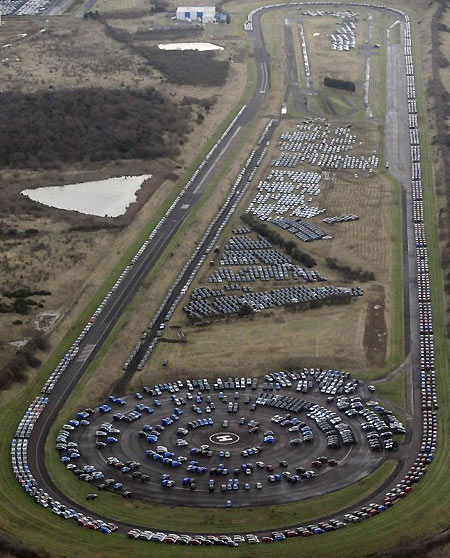 It should be obvious to all that we are entering a global depression. I ask all of you, in your lifetime, have you ever witnessed anything like this? I know there are a lot of super smart economists, analysts, investors and pundits that may say otherwise, but I query, who are you gonna trust, them or your LYING eyes?! Why wasn't there so much doubt over the last 15 years when we were experience a global equity and asset boom? I know, I know... Things can go up and do well, but they really can't go down and go bad.
Reggie Middleton is an entrepreneurial investor who guides a small team of independent analysts, engineers & developers to usher in the era of peer-to-peer capital markets.
1-212-300-5600
reggie@veritaseum.com


